Showing posts with label conflict affected states. Show all posts

Thursday, 26 January 2012

CIDA and CSR

I don't know enough about this topic to comment adequately. But I know that CIDA's new corporate social responsibility strategy - funding corporations' CSR programs - is controversial, particularly when CIDA is cutting funding to NGOs.

CBC's The Current does a much better job at looking at the debate. Today's program devotes a half hour to this topic. You can listen to it on their Past Episodes page.  

Tuesday, 30 August 2011

Iraqi men give advice to Libyans (also presumably men)

I was a little peeved by this article by Michael Schmidt in the NYT's on advice Iraqis could give to Libyans post "Liberation".

I though the premise was ok, interesting even. The situations are not that similar, but enough so for journalists to make comparisons. But I was extremely disappointed to read that the viewpoints solicited were only from men.

I worked in Iraq for a while. I can think of a few women there that would have some sound advice for Libyans, particularly concerning the erosion of women's rights and the rights of minorities. Are the viewpoints of men the only voices that count? And the Libyans receiving this advice – are they also only men?

There is a paucity of women present in the rebel movement to topple the Ghaddafi regime. I think there is one in the transitional council (responsible for legal AND women's affairs). The violence has taken focus away from the fact that after Ghaddafi, freedom – or liberation as the article puts it - may only exist for men in Libya. Unlike in Egypt where the participation of women in the revolution was lauded, and the exclusion of women from decision making decried, we are extremely silent on what the Libyan revolution means for half the population of the country. There are a few accounts of females fighting or on life at the home front but much of the media coverage only shows men.

I would be extremely interested to see an article showing the views and suggestions of various members of the population, including women, but also of different ages, backgrounds and locations. Iraqis have a lot of advice to share about experiments in statebuilding - male and female.

Tuesday, 23 August 2011

Posters and GBV


In Sierra Leone, there is a clear public campaign to counter sexual exploitation and assault of women. This is in the professional and domestic sphere. I saw a number of posters and billboards with women being harassed or in imminent danger of being beaten - I particularly enjoy the use of posters from the Ghanaian Commission on Human Rights and Administrative Justice (my old stomping ground) - reminding us that sexual abuse and exploitation is not acceptable and is punishable. Some are in Krio -possibly much more useful then straight up English for billboards at least - and seem to act as a reminder to men not to prey on women. I did not see any posters in Salone with men being abused by women, unlike in Ghana.


Gender based violence and exploitation is endemic in Sierra Leone, from cultural initiations into secret societies that involve genital cutting to human sacrifices (there's concern of this increasing in the lead up to the elections next year). I'm working with the police, and sexual harassment and exploitation is more than just common place. Fortunately this is an area that is heavily supported programmatically and institutionally (for example the SLP has a new Sexual Harassment Policy and a complaints division), but as of yet it's difficult to tell if this is making a difference. Or whether this is just lip service. I didn't really see many posters IN police stations or headquarters reminding people that sexual exploitation, assault, or domestic violence is wrong (there were large billboards beside or in front of some police stations in Freetown at least). I only conducted a basic search for information on how effective the posters are. Obviously many poster campaigns are coupled with use of other media (radio discussions/adverts, television, comic strips, public protest, training and workshops etc). But I couldn't really find anything - I'm not sure if anyone has any suggestions.


While we're on this topic, there was an interesting article in Foreign Affairs on the reliability of rape reporting numbers during war.

Tuesday, 16 August 2011

Liberia's Bike Riders

Motorcycles are everywhere in Monrovia.

During the Liberian civil war combatants and refugees sought refuge in neighbouring Guinea. Inspired by the enterprising young Guineans running their own business, Liberians returned with an idea to fill the transportation gap in their country ravaged by years of war. Former Combatants used the money they received from the DDRR process to purchase inexpensive Chinese motorcycles and lease them to drivers.

The business model exploded.

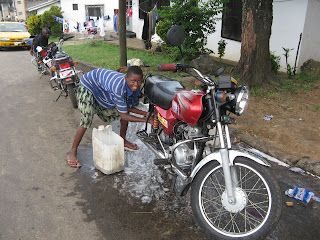
The work serves as good employment for scores of unemployed young men - an estimated 75% or more are former combatants. It also provides employments for younger members of society, as motorcycles washers. The children use the money to pay excess school fees.

But the model isn’t perfect. This mode of transportation is dangerous. Daily there are several crashes resulting in severe injuries and sometimes death. The bikers do not wear protective gear – neither do their passengers – and outside Monrovia, it’s rare that they have a license. The bike riders have a tenuous relationship with the police and some members of the community who see the bike gangs as unsafe. Altercations with the police have left some police stations up in flames. Police and community members know bike riders can organise quickly and as a result there is unease about the gangs of bike riders.

It’s something the police are going to have to work with. Motorcycle taxis, or “motos” as they are known in some areas are becoming an increasingly common mode of public transportation in West Africa. It is inexpensive, the bikes are easy to maintain, and business is flourishing as a result of limited public transportation options. More importantly, they are fast. They can weave in and out congested traffic on overcrowded streets.

There is work to further professionalize the practice – realising that it provides much needed employment to young men (from what I’ve gathered there aren’t any female bike riders). NGOs, the UN and even the World Bank have worked with the Bike Riders Association – their informal union – to increase licensing, encourage safer practices and facilitate dialogue between the police and the bike riders. These actions have some effect, yet more is likely needed to improve the safety of the community and the riders themselves. Much more needs to be done to build trust between the police and the bike riders.